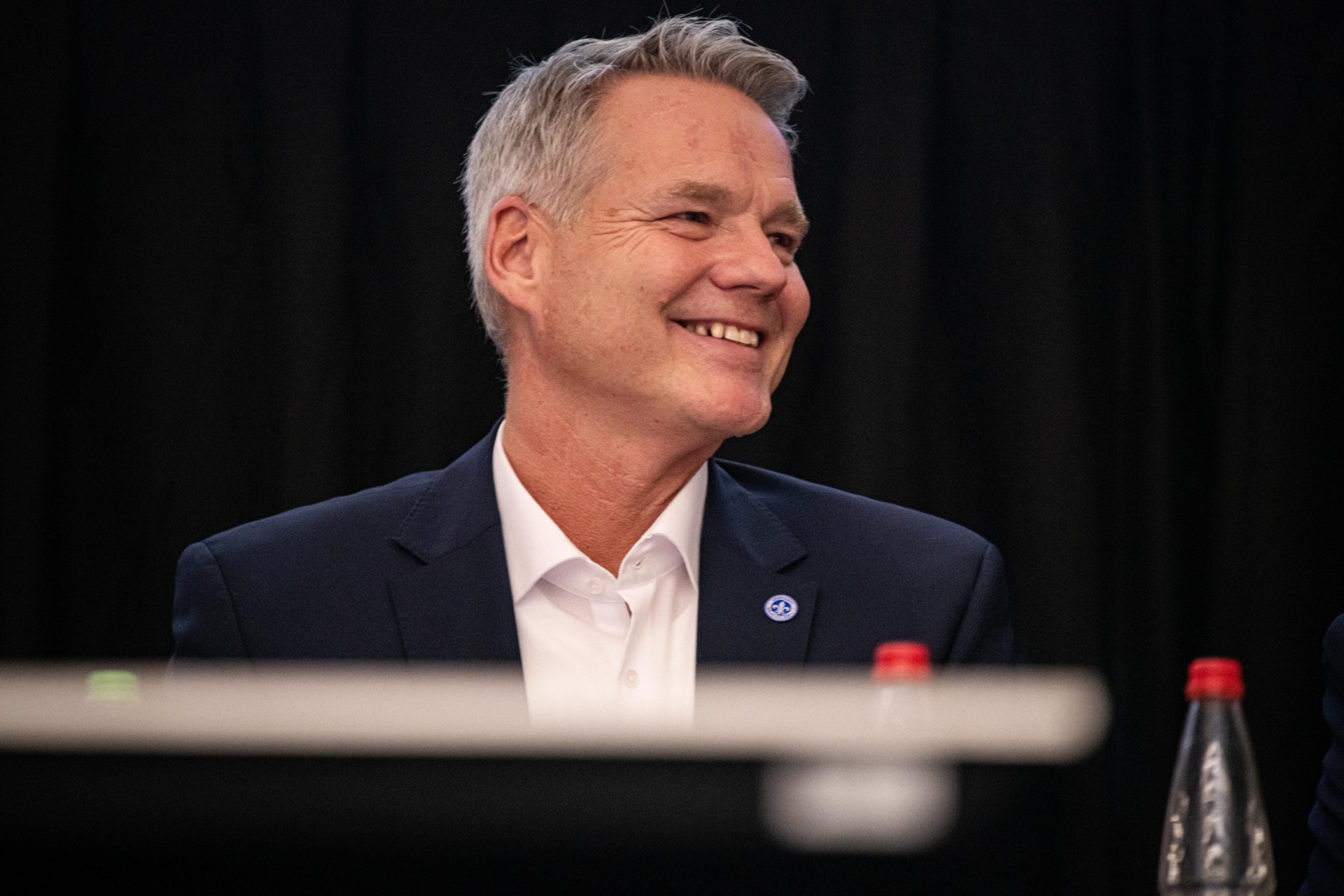
sv98.de: Markus Pfitzner, you’ve been president of SV Darmstadt 98 for about a month now. Have you gotten through all the congratulatory messages yet?
There were indeed countless calls, emails, and messages. I was truly overwhelmed. The messages didn’t just come from the sports world. Numerous contacts from my professional life, who know about my long-standing connection to the Lilies, also sent me very personal messages. So there was a lot of support and congratulations on this successful transition from within the club. It speaks volumes for Darmstadt 98 that the transition went so smoothly; that’s not something you see every day, especially in professional football.
Are you taking on an easy legacy, because SVD is probably in better shape than ever, or a difficult one, because you have to continue this successful era?
A bit of both. First of all, we are in a stable position as a club. That’s a good foundation for a change, even though it represents a significant shift after the successful period under Rüdiger. At the same time, the stakes are high, as we are in an extremely tough competition. We have to try to push ourselves to the limit every year. We can succeed if we maintain the cooperation and unity that characterise us as a club. I called them our superpowers at the members‘ meeting. Nevertheless, we want to be open to new and innovative ideas. That will be challenging, but we are confident we can do it in our new setup. Anne Baumann and Volker Harr have been with us for a long time. With Arnd Zinnhardt and Roy Reinelt-Peter, we have gained two energetic new members. We are well prepared.
Why is this unity, which you describe as a superpower, so important to you?
It has been our key to success all these years. Because it’s palpable around the Lilies on many levels: in the relationship between fans and the club, among the fans themselves, but also within the club. If I look at the board, for example: even when we had differing opinions on some issues, we all supported the decisions once they were made. I think that was noticeable to the outside world. I’m sure that will also be the case in the new constellation, because with Roy Reinelt-Peter and Arnd Zinnhardt, we’ve gained two people who have already contributed an incredible amount to SV 98 in the past. We all bring different strengths. Something new can emerge from this mix without straying from our path.
You’re a marketing expert yourself. How does that help you better understand and contribute to the development of a business like SVD today?
To be honest, in my career I’ve been able to transfer more insights from sports to my work. For example, when it comes to strategic issues or how to build a successful team. There are many things that can be applied in merchandising and licensing. But ultimately, there are still huge differences. The emotions that sports evoke and its constant dynamism are far more challenging than any task in industry.
Even if the professional footballers dominate everything, you are still the president of the entire club. What role does leading an amateur sports club play in your term of office?
Our commitment to being a multi-sports club is important to us. We want to support our departments as best we can and perhaps establish more to broaden our reach and give even more people the opportunity to participate. I see great potential for strengthening amateur sports. This would lead to further social integration in the city and the region. It’s not always just about the 90 minutes on the weekend. We want to reach out to people and get them excited about our club. Not just because someone is a football fan, but because they are looking for the opportunities and the sense of community at Darmstadt 98. Furthermore, there are partners who would certainly be happy to support amateur sports. Not everyone wants to be on the advertising boards right away. So we want to keep a very open mind about what would be a good fit for us and where we can expand our presence.
You just mentioned that you come from a different era. How and when did it all begin for you with the Lilies?
I first went to the Bölle stadium in 1978 when I was nine years old, holding my father’s hand. The Lilies were playing their first Bundesliga season back then, and at first, I didn’t really understand what the fans were chanting. So I had to ask my father what it meant. I had to learn how to shout „Lily!“ (laughs) My first match was a 1-6 loss against Fortuna Düsseldorf. But I didn’t think the result was so bad. I was captivated by the whole atmosphere, this emotional sense of community. It still motivates me today. To feel what the club means to so many people. That the Lilies represent a part of life, a part of community, a sense of belonging. Understanding that is still important to me.
What happened next with you and the Lilies?
For a long time, I went to the stadium with my dad and his friends. Because in my class, hardly anyone had the Lily (the German fleur-de-lis) on their school notebook. Bayern Munich, Stuttgart, and HSV (Hamburger SV) were all the rage back then. Eventually, I broke away from my father’s group of friends, as I found two or three buddies with whom I always hung out at the fence.
There’s a great picture of you from 1983. As a 14-year-old, you were walking around town advertising a Darmstadt 98 match against FC Schalke 04. How did that come about?
I can’t really say for sure. I think the Merck company was very involved with the club’s marketing back then. Since my dad worked at Merck, I was probably approached through that connection. I enjoyed doing it with a friend. If I remember correctly, the reactions to the campaign were mixed (laughs). Unlike today, the stadium wasn’t always sold out back then. You needed some creative ways to get people to know about the games.
You already mentioned your father. What role did Darmstadt 98 play in your family?
I come from a family of sports enthusiasts. My father, in particular, was a huge football fan. So it was only natural that I would eventually become a Darmstadt 98 supporter, even though neither he nor my mother are from Darmstadt. So, strictly speaking, I’m not a true-blue Heinz native, even though I was born here and grew up in the Heimstättensiedlung housing estate and later in Arheilgen. I still remember the Bundesliga conference on the radio. It was a fixed ritual for us on Saturday afternoons. I practically crawled right into the radio.
You’ve remained loyal to Darmstadt and even grown closer to the club. It all started with your work on the Lilienkurier (Darmstadt Courier).
That was in 1993. Darmstadt had just been relegated from the 2. Bundesliga to the Oberliga (fifth tier). Until then, the kicker magazine in Nürnberg had provided the content. But that cost money, which was scarce in the Oberliga. At the time, I was studying journalism in Mainz and offered Darmstadt 98 that I would take it over. I also had to sell advertising on the side. The problem was, nobody wanted to advertise. So the first issue of „my“ Lilienkurier consisted of just a photocopied sheet. There simply weren’t any advertisers. It was a different time, but for me personally, it was an exciting start because the club had very small structures. In a way, things have come full circle now, as I get to give my first interview as president to the Lilienkurier.
It shouldn’t be your last job with the 98ers.
That’s right. I also sold the very few fan items. It was maybe only half a metre of shelf space. A mug, a scarf, not much more. I briefly helped with membership administration. But frankly, that wasn’t really my thing. Eventually, I started moderating the press conferences. I was able to do a lot of different things from the ground up and keep learning.
And this was at a time when Darmstadt 98 really wasn’t popular.
Just like with the sponsors, fan interest also waned. This also meant that, especially during the Oberliga (fifth tier) days, it was difficult to find people to travel with for away games. But we were at least a small, dedicated group. In addition, I took on another job: as mentioned earlier, I started moderating the press conferences at home games. Beforehand, I had to get the results of the other matches from the teletext in the announcer’s booth. If they were purple, the game was still in progress; only when they were white was the result final.
In the 1990s and 2000s, Darmstadt 98 bounced back and forth between the third and fourth divisions. At times, fewer than 2,000 spectators came to the Bölle stadium. Didn’t you also experience a period of estrangement from Darmstadt 98 back then?
No, I didn’t, mainly because of my continuous involvement with SV Darmstadt 98. I had a solid network here. We were a small team that was always there, it seemed. That creates a bond with the club. But in the city, of course, it was different. There was definitely an estrangement there. I still remember when the team held an autograph session at the savings bank during the Regionalliga era, and (Managing Director, ed.) Michael Weilguny and I walked across Luisenplatz and asked people if they wanted to come. But hardly anyone did. Fortunately, those days are over (laughs).
Given your extensive involvement over the years, was joining the board in 2010 a natural next step?
Hans asked me, and initially, I said no. I was a bit apprehensive. After all, I’d seen what had happened to some of the previous board members. It’s not an easy position. Not everyone has been celebrated for their work. So, I had reservations, and Hans asked me to think it over calmly. I reconsidered and agreed. It all started in 2010, and things got off to a good start on the pitch. In 2011, we were promoted to the 3rd division, which we managed to stay in two years later, albeit with some luck. The rest is history.
You’ve been looking behind the scenes of professional football for quite some time now. How much has your experience as a fan changed through these insights?
I’d be lying if I said it hadn’t changed over the decades. Sometimes, after a bad game, I wish I could just vent my frustration and quickly put it all behind me. Having an overview of the business side of things, I have a different perspective. That means a lot more pressure. With every match, you know exactly what’s at stake: the structures, the staff, what we’ve built and what we can be proud of. Especially in the 2. Bundesliga, things are incredibly dynamic. That’s why I appreciate how closely we, as Darmstadt 98, are connected in our core structures. The very open and familial atmosphere we cultivate and the great trust we have in one another. We’re the antithesis of clubs that tear themselves apart in power struggles. Many of us have been around for a long time and know the tough times. That keeps you grounded.
Looking at day-to-day operations, how do you perceive the current working atmosphere within and around the team?
When things are going well on the pitch, it takes a lot of pressure off everyone. However, in times of sporting crisis, you have to work even harder to keep everything together. Currently, I find the cooperation across the entire office, with its nearly 40 people, to be very, very positive. Many started here through internships, traineeships, or as apprentices and have now been here for many years. This creates a good atmosphere. Our managing directors work well together. The connection to the professional team is good. We, as the board, see it as our responsibility to support and strengthen the full-time staff and to further professionalize the organisation. It’s extremely important to us that there’s good cooperation in our hectic and dynamic daily operations, that we have a positive culture, and that we are team players.