„A cup battle that we embraced and won“
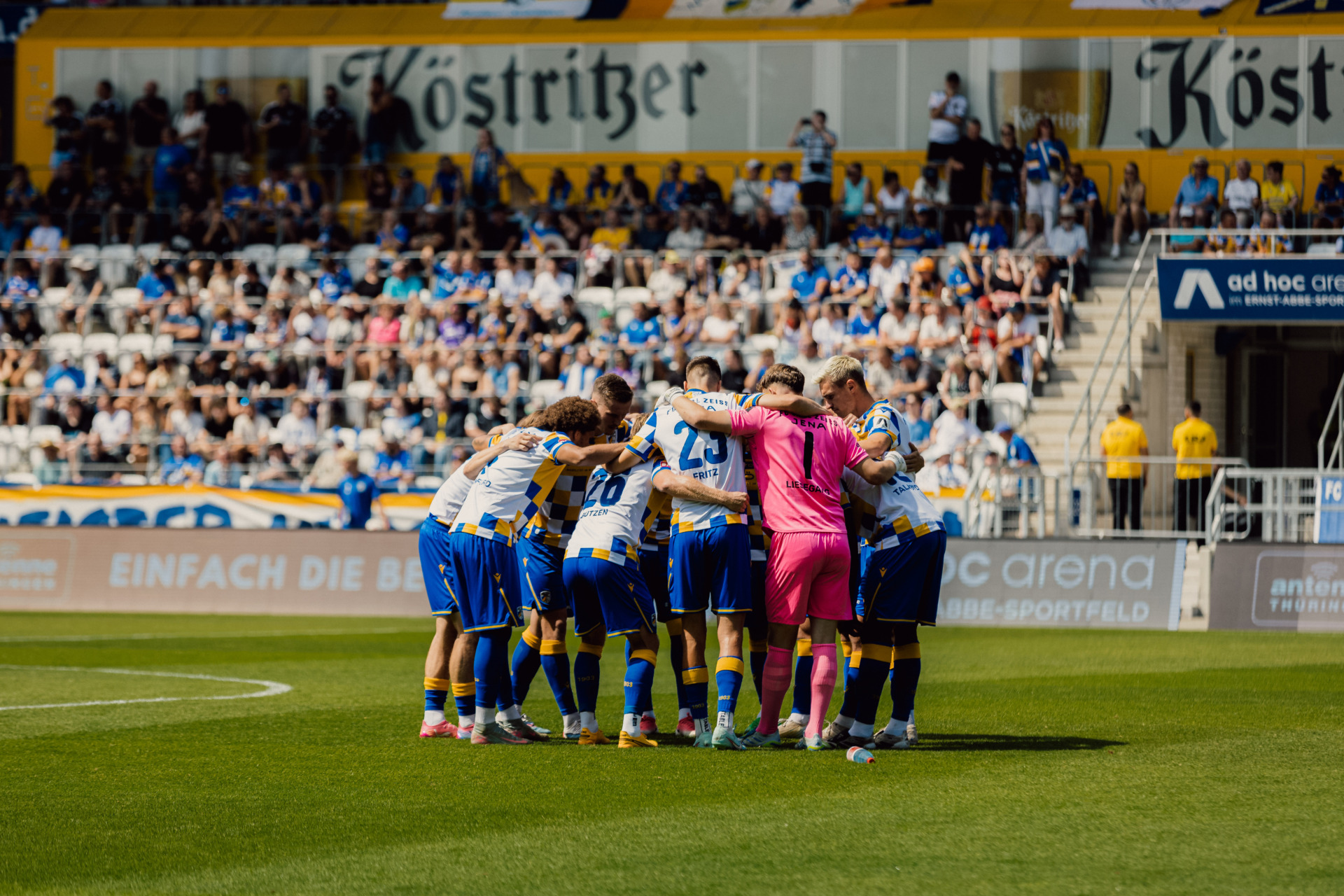
The Lilies have reached the second round after a hard-fought cup match in Jena. We’ve rounded up the post-match reactions for you.
Floodlights illuminate the pitch at Düsseldorf’s Rheinstadion as the FC Carl Zeiss Jena players step onto the field on May 13, 1981. Behind them lies a European campaign that has long since made football history: coach Hans Meyer’s team had already overcome AS Roma, Valencia CF, Newport County, and Benfica on their journey through the European Cup Winners' Cup. Now, just 90 minutes stand between them and ultimate triumph. Waiting on the other side is Dinamo Tbilisi. It is the biggest European night in the club's history—and even though it ends in a 2 - 1 defeat, this extraordinary journey remains inextricably linked to FC Carl Zeiss Jena to this day.
The history of FC Carl Zeiss Jena dates back to 1903. The club was founded on May 13 as the „Carl Zeiß“ Jena football club, though it underwent several changes to its name and organisational structure over the decades. Since 1939, the club’s historic home ground in Jena has been known as the Ernst-Abbe-Sportfeld. Following World War II, football in the city had to reorganise; the path led through various sports associations before eventually resulting in the formation of SC Motor Jena. In 1966, this evolved into FC Carl Zeiss Jena, adopting the name it bears today.
FCC experienced its most successful era primarily during the 1960s and 1970s. Jena won the East German championship for the first time in 1963, followed by two further titles in 1968 and 1970. These achievements were complemented by four cup victories and numerous international appearances. The club’s greatest success on the European stage came in 1981: after a remarkable run, Jena reached the final of the European Cup Winners‘ Cup, though they were ultimately defeated 2 – 1 by Dynamo Tbilisi in Düsseldorf.
Even after German reunification, FCC remained a fixture in German football, playing in the 2. Bundesliga for several years. Another cup highlight occurred during the 2007/08 season, when Jena eliminated opponents including VfB Stuttgart to reach the semi-finals of the DFB-Pokal. Today, the historic club competes in the Regionalliga Nordost.
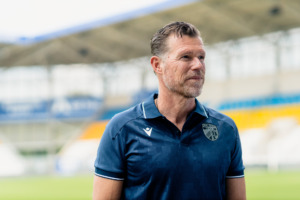
Marco Grote
Head coach of FC Carl Zeiss JenaFC Carl Zeiss Jena is displaying a rock-solid defence at the start of the new season. In their first five Regionalliga Nordost matches, the team conceded just four goals and kept three clean sheets. The defence has been particularly secure away from home so far: FCC secured 1–0 victories against both SV Babelsberg 03 and BSG Chemie Leipzig. Jena also kept a clean sheet during their emphatic 4–0 home win over RSV Eintracht. Consequently, Carl Zeiss has managed to keep a clean sheet in three of their five league games to date.
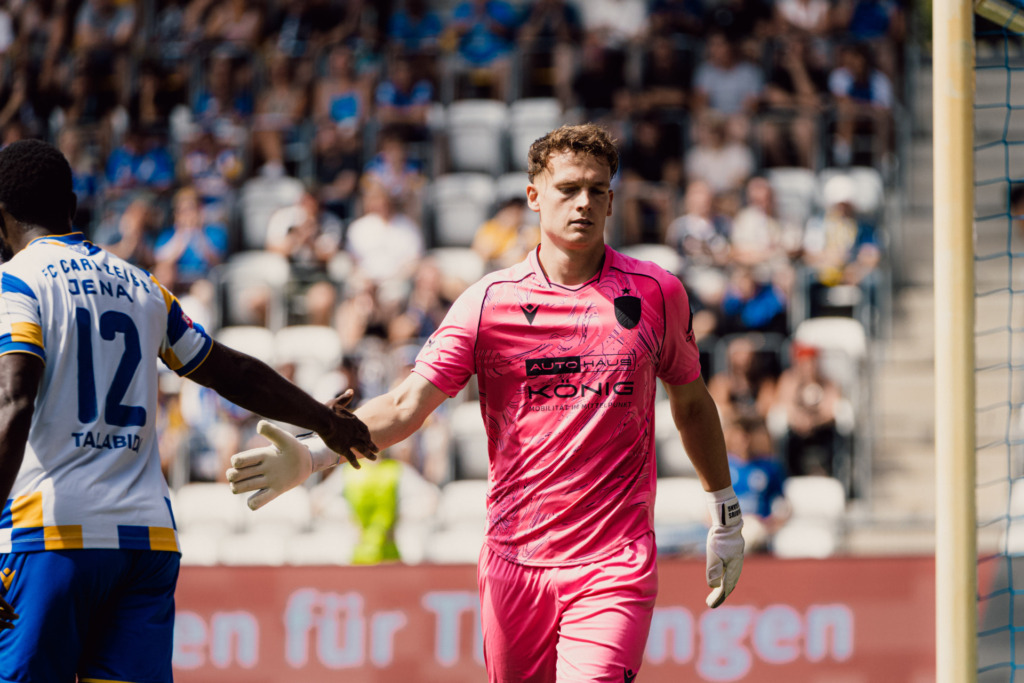
Marius Liesegang was born in Magdeburg in 2000 and grew up in a highly athletic family. His father, Sven Liesegang, was a successful handball player who won the Champions League with SC Magdeburg in 2002. Marius, however, chose football and decided early on to take on the specialised role of goalkeeper. He took his first steps at 1. FC Magdeburg, progressing through all the club’s youth teams. In 2016, he moved to the youth academy of 1. FSV Mainz 05.
Liesegang continued to develop steadily in Mainz. He initially guarded the goal for the U17 and U19 teams before making the leap to the club’s second team. There, he gained his first experience in senior football in the Regionalliga Südwest. His progress was recognised by the club: in 2020, at the age of 20, he signed a professional contract with the Bundesliga side and began training regularly at the highest level.
In January 2022, Liesegang left Mainz to join Dynamo Dresden, who were then in the second division. Although he was part of the professional squad at SGD, he did not make any competitive appearances during the second half of the season. After six months, he headed north, joining FC Teutonia 05 Ottensen in the summer of 2022. In Hamburg, he gained the regular playing time he had previously lacked and established himself as the first-choice goalkeeper in the Regionalliga Nord. In total, he made 65 appearances for Teutonia. A highlight of his time there came in August 2023, when he faced the eventual German champions, Bayer Leverkusen, in the DFB-Pokal as part of the underdog squad.
For the 2024/25 season, Liesegang joined FC Carl Zeiss Jena. At this club with a rich history, he quickly assumed the role of number one goalkeeper and established himself as a reliable last line of defence. With his composure, presence, and footballing ability, he has become a fixture in the Jena goal. In his first two seasons with FCC, Liesegang made 67 competitive appearances, keeping 23 clean sheets.
Their shared journey continues in the summer of 2026. Although other options were available to him, Liesegang extended his contract in Jena early, running until 2027. For the now 26-year-old, staying put was—in his own words—a decision made „straight from the heart.“ The club, meanwhile, regards him as a reliable constant and a vital part of the squad. Liesegang has thus found a sporting home in Jena—and, following his time in youth academies and stints in Dresden and Hamburg, has firmly established himself as a first-choice goalkeeper in senior football.